


November 16, 2026
Inside SynchroGrid’s Experience at CPS 2026
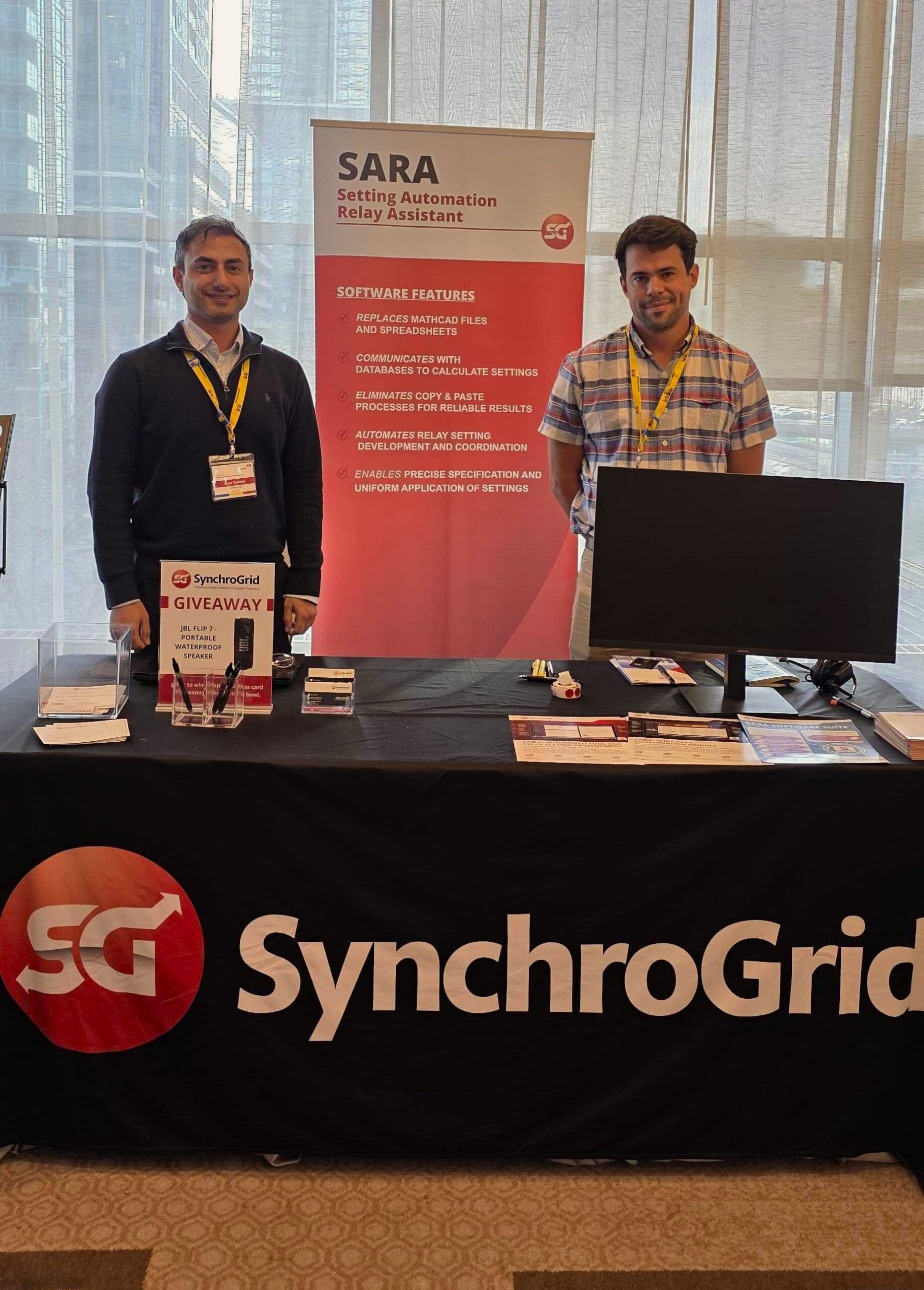
SynchroGrid was proud to exhibit at the 11th Annual Canada Protection Symposium (CPS) in Toronto, bringing together protection engineers, utility professionals, and industry leaders to explore the future of power system protection and automation.
Highlights from Our Table
At our table, we gave attendees a sneak peek at AARMI (Automated Analysis of Relay Misoperations), the new software product we’ve been developing to automate the forensics of relay misoperation analysis. When a protection system operates, the questions are always the same: what happened, was it correct, and what do we tell NERC? AARMI reviews event data, including COMTRADE oscillography, CEV event reports, SER records, and as-found settings, and returns a verdict, an event timeline, and a draft NERC PRC-004 report for engineer review. The preliminary demos gave engineers a first look at what we’ve been building.
We also featured live demonstrations of SARA (Setting Automation Relay Assistant), showing how it helps utilities modernize relay setting workflows through improved accuracy, consistency, and engineering efficiency. SARA’s integration with CAPE and ASPEN OneLiner™ lets engineering teams work within their existing protection study environments with greater flexibility.
Throughout the event, our team engaged in valuable discussions on evolving grid challenges, automation, and compliance, including how SynchroGrid’s consulting services support relay setting development, protection coordination studies, and NERC PRC compliance.
Technical Presentation
Our first symposium paper, “A Comparison of Deterministic Automation and Machine Learning-Based Approaches for Protective Relay Settings: A Formal Specification Perspective,” presented by Luke Hankins, P.E. and Reza Teshnizi, PhD, showed that deterministic automation provides an error-free, regulation-compliant, and auditable relay settings calculation process. We also explored where machine learning adds real value in protection engineering, including fault detection, classification, and coordination optimization, and why it is not the right tool for settings computation where precise numeric values matter. Thank you to everyone who attended the session!
Thank you to everyone who visited our table and attended our technical presentation. CPS 2026 was an excellent opportunity to connect, share insights, and continue advancing the field of power system protection.
We look forward to building on these conversations throughout the year ahead.